When a child chokes at an institution fair or an older neighbor breaks down at a neighborhood conference, the very first individual to act is seldom a physician. It is usually a parent, a coach, a confidence leader, or a volunteer that took place to be close by. That space in between incident and ambulance is where fast first aid training gains its value.
Many volunteers recognize this, yet they are reluctant to enlist because they expect long days in a classroom, complicated clinical lingo, and thick guidebooks they will certainly never open up once again. Done badly, a first aid course can feel precisely like that. Done well, fast first aid courses offer busy neighborhood leaders useful abilities in a concentrated, time-efficient layout, without watering down the essentials.
This guide makes use of what really assists individuals do under pressure, not simply pass an assessment. If you organise events, lead a regional team, or coordinate volunteers, you are exactly that fast first aid and CPR training is made to support.
Why speed issues for neighborhood training
Community volunteers reside in the real life of childcare pickups, change work, and restricted budget plans. Asking to go to a two-day first aid and CPR course with traveling and overdue pause usually suggests they never ever enlist. The result is a community full of eager assistants that feel unprepared.
Fast first aid training deals with three useful constraints.
First, time. A well made express first aid course respects that participants will only maintain a minimal number of abilities, so it concentrates on the ones that save lives in the very first minutes: CPR, choking, serious blood loss, unconsciousness, and a few key injuries.
Second, attention. Most people learn much better in short, intense bursts than in lengthy lectures. Fast first aid courses make use of scenarios, hands-on method, and quick responses loops as opposed to long academic presentations.
Third, urgency. Community occasions relocate promptly. When something fails, a leader requires a clear mental manuscript: inspect safety and security, call for help, begin one of the most essential interventions. Fast first aid training classes are built around that script to ensure that the best actions surface under stress.
Speed, nevertheless, does not mean reducing edges with safety and security or top quality. The objective is not simply a fast certification, it is reliable, repeatable abilities that work in the messiness of genuine life.
What "fast" ought to and must not mean
I have seen two really various versions of fast first aid courses.
One version crams the same product right into much less time, typically by skipping method or hurrying analyses. Participants entrust to a first aid certificate yet little self-confidence. They could keep in mind the recuperation placement for a week or two, but months later on, the details blur.
The various other model is careful. It approves that you can not master everything in three or 4 hours, so it focuses ruthlessly on:
- The top couple of emergency situations more than likely to happen in that community The activities that provide the greatest benefit in the tiniest time Simple methods that are easy to remember a year later
If you are reviewing a fast first aid course near you, search for this 2nd design. It will feel oddly straightforward in the moment. That is deliberately. You are not training to be a paramedic. You are training to be an effective very first -responder up until paramedics arrive.
The word "fast" should define the distribution approach, not the state of mind. The course itself could be much shorter, but it needs to still include actual method, instructor comments, and time to ask questions concerning unusual situations you have in fact encountered at events.
Skills that make the largest difference
In neighborhood settings, particular emergency situations repeat: choking at a bbq, upper body discomfort at a meeting, sporting activities injuries at youth programs, fainting in queues, cuts from devices at working , and clinical episodes like asthma or diabetes.
A strong fast first aid or express first aid training course tends to focus on a core set of skills.
CPR and use defibrillators
Cardiac apprehension is ruthless. Survival goes down with every min without reliable CPR. That is why premium quality CPR training sits at the centre of any kind of first aid and CPR course.
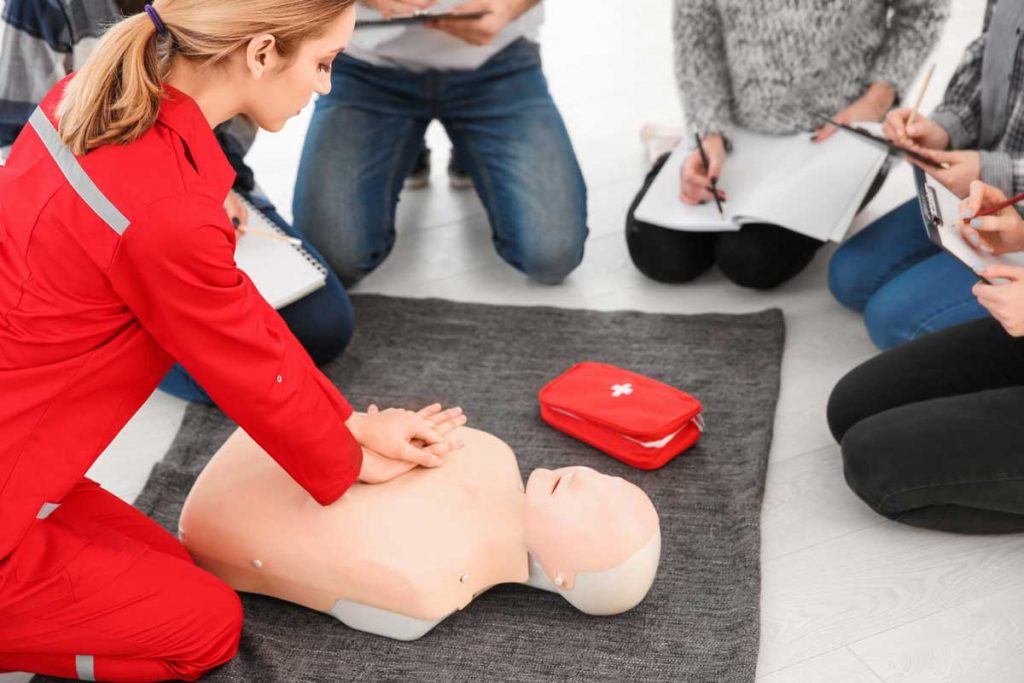
The most effective CPR courses for volunteers take a straightforward strategy. They do not sink you in proportions or edge-case variants. They show a clear series, they pierce it continuously on manikins, and they build comfort with automated outside defibrillators (AEDs), which are progressively typical in area locations. An express CPR course can be as short as 1 to 2 hours, yet still transform how ready somebody feels to tip in.
I have actually watched nervous individuals at the beginning of a fast CPR course hardly touch the manikin. Ninety mins later they are counting compressions aloud with strong strategy and a clear plan for calling for assistance. That change just happens when technique time is secured, also in an express CPR training format.
Choking and respiratory tract problems
Choking events often happen in busy, loud environments where panic spreads out quickly. Recognizing exactly how to acknowledge partial versus total obstruction, just how to provide abdominal drives, and how to modify your method for a baby or expecting person is crucial.
A great first aid and CPR training class utilizes reasonable role play. You will certainly stand up, support a partner, and mimic back impacts https://spencergoxb195.theglensecret.com/exactly-how-to-pass-your-fast-first-aid-course-on-the-first-try and thrusts. It feels significant in the classroom, but that physical memory is exactly what takes control of when a genuine kid starts to choke on a grape at a neighborhood lunch.

Severe bleeding and wounds
External bleeding is one of the most aesthetic and challenging emergencies. Individuals usually freeze or undervalue the urgency. Efficient fast first aid training educates an extremely straight strategy: reveal the wound if safe, use solid pressure, add dressings, and do not eliminate soaked bandages.
It likewise helps participants consider improvisated materials. At a local event, you may not have actually a stocked first aid kit within arm's reach. A folded Tee shirts, a tidy towel, and even your very own hand with a handwear cover can serve up until a correct plaster arrives. The goal is simplicity, not book perfection.
Unconsciousness and the healing position
Finding somebody unresponsive but breathing often agitates also experienced volunteers. A solid fast first aid course will certainly walk you step by step with inspecting responsiveness, opening the respiratory tract, assessing breathing, and placing the person into a recovery setting while safeguarding the neck and keeping the respiratory tract clear.
Practice matters right here. Numerous individuals only know just how awkward it can be to roll a grown-up right into a stable placement once they attempt it on the flooring. A classroom that lets you in fact roll a partner is far more beneficial than one that just reveals diagrams.
Common clinical conditions
Community leaders are not expected to identify, yet they can acknowledge patterns. Short, focused first aid training can cover traditional indications of bronchial asthma attacks, extreme allergies, diabetic hypoglycaemia, and strokes, with simple actions to take while waiting for professionals.
Here, the subtlety depends on preventing overconfidence. An excellent teacher will certainly emphasize that your job is to stabilise, not address. Give prescribed medication if the individual can manage it, call emergency solutions early, and monitor modifications, rather than trying amateur clinical decision making.
Express childcare first aid for youth workers and parents
Childcare atmospheres and youth programs existing specific difficulties. Youngsters collapse right into each other, explore foods, and go through fast temperature level modifications between tasks. An express child care first aid course recognizes this truth and concentrates on situations that staff and volunteers really encounter.
In my experience, the most useful express childcare first aid training includes a couple of extra elements beyond general very first aid.
First, youngster and infant CPR. The auto mechanics, depth, and ratios vary from adult CPR, and lots of people feel especially nervous regarding pressing on a toddler's breast. Numerous brief cycles of method on infant and kid manikins construct trust in your hands.
Second, taking care of small but remarkable injuries. Nosebleeds after playground accidents, divided lips, and knocked-out teeth all create considerable distress in kids, parents, and team. Clear, practiced regimens tranquil everyone. Fast first aid courses tailored to childcare frequently supply easy scripts you can duplicate to both the kid and their caregivers.
Third, anaphylaxis and allergic reaction monitoring. With increasing allergy occurrence, recognizing how to identify an allergic reaction, utilize an auto-injector, and coordinate with emergency services is non-negotiable in child care and institution setups. Express child care first aid courses now usually include auto-injector practice on trainer devices.
Fourth, communication with parents and documents. Volunteers and teachers commonly stress over what to create after an event. Training that consists of actual example forms and brief debrief strategies aids maintain count on and legal protection.
Express childcare first aid courses do not attempt to turn educators right into registered nurses. They furnish them with a steady, rehearsed action for the sort of injuries and illnesses that appear every day among children.
Structuring fast first aid and CPR training for an area group
When I deal with area organisations, one of the most effective programs rarely start with "What content should we cover?" Rather, they start with "When something goes wrong at one of our events, who actually acts, and where are they standing?"
Take a local sporting activities club as an instance. Coaches are on the field, moms and dads are on the sidelines, and the club secretary could be in the canteen. Each has different visibility and different time to respond. A fast first aid course for this team could be structured right into 3 brief modules throughout a single evening.
The first module concentrates on instant, on-field activities: analyzing danger, managing spine issues, regulating bleeding, and asking for help.
The second concentrates on CPR and making use of the club's AED, due to the fact that cardiac arrests, though uncommon, have devastating effects in sport.
The third covers typical however much less vital injuries such as sprains, small fractures, and heat-related illness, in addition to basic return-to-play guidance while stressing that clinical clearance comes from wellness professionals.
Across these components, the exact same core principles are duplicated in various contexts. Safety and security initially, quick analysis, easy interventions, very early escalation.
Fast CPR refresher courses fit neatly right into this model. As opposed to re-teaching every little thing every year, a 60 to 90 min fast CPR course can review core methods, correct drift in hand placement or compression depth, and incorporate any kind of adjustments in standards. Participants appreciate that their previous knowing is valued, not reset.
What every fast first aid course ought to include
Not all first aid training is produced equal. Fast layouts particularly vary widely in high quality and emphasis. When you are selecting express first aid courses or fast CPR courses for your volunteers, look for these core components.
Clear learning end results that match your context, not generic promises. Substantial hands-on experiment CPR manikins, healing placements, and fundamental bandaging. Scenario based discovering that mirrors your actual area setups, such as fetes, games, or services. An assessment process that checks both skills and self-confidence, not simply written answers. An identified first aid certificate that satisfies governing or organisational requirements.If a company can not explain how they balance speed with these fundamentals, treat that as an indication. A fast first aid course that provides a certificate without genuine skills leaves your volunteers bring both obligation and doubt.
cpr refresher course HobartChoosing the best provider and format
Typing "fast first aid course near me" or "express CPR course" right into an online search engine will certainly generate loads of outcomes. Arranging with them calls for greater than contrasting prices.
A short, structured list helps.
Accreditation and acknowledgment: Ensure the company's first aid and CPR courses meet local governing standards for workplaces, childcare, or education, depending on your needs. Trainer experience: Teachers who have real-world clinical or emergency situation histories bring subtlety that scripted presenters frequently lack. Ask how they handle questions that go "off curriculum." Delivery format: Many organisations currently provide combined knowing, where theory is completed online and practical parts are delivered personally as a fast first aid training session. For active volunteers, this layout can reduce time on site while protecting hands-on practice. Group customisation: Neighborhood groups benefit when examples and scenarios mirror their actual activities. Ask whether the provider adjusts material for sporting activities clubs, belief neighborhoods, area residences, or youth organisations. Post course assistance: Seek brief referral guides, refresher reminders, or access to follow-up inquiries. Abilities discolor is actual, especially for individuals that rarely use their training.
Sometimes, the very best option is to bring express first aid training on-site. Holding a course in your very own hall or clubroom reduces traveling, constructs shared understanding amongst your team, and urges support from leadership that can see the worth firsthand.
Balancing legal, honest, and practical concerns
Volunteers and leaders typically lug peaceful fears that maintain them from acting. They ask whether they can be filed a claim against if they slip up, or whether they are even enabled to touch somebody in an emergency.
A thoughtful first aid course addresses these issues straight. While laws differ by area, lots of territories identify "good Samaritan" principles that secure people that give first aid in great faith. Your teacher ought to clarify the basics relevant to your location and strengthen that not doing anything in a harmful emergency situation can be extra unsafe, ethically and almost, than attempting experienced interventions.
Consent is one more vital subject. When an individual is conscious, you need to always ask prior to offering help, also if it is as easy as "I have first aid training. Can I assist you?" If they are less competent, the regulation typically thinks they would want lifesaving aid. Clear explanation throughout training constructs self-confidence to act instead of stand back.
Practical borders are equally as vital. Volunteers need to recognize where their duty finishes. A fast first aid or FAP first aid course that consistently reinforces "initially do no further damage, then seek specialist aid" aids stop sympathetic but risky activities, such as relocating somebody with believed spine injury without urgent danger.
Keeping abilities fresh without overwhelming people
A solitary express first aid course can develop a sharp spike in confidence, followed by progressive decrease as months pass without method. For community groups, the obstacle is to keep abilities active without asking volunteers to frequently attend full length courses.
Short, concentrated fast CPR correspondence course annually or every couple of years supply an effective concession. They can be slotted into existing conference timetables, such as a pre-season instruction or annual planning day. These refresher courses can likewise update volunteers on any changes in resuscitation guidelines or local emergency situation procedures.
Informal practice helps too. I have seen clubs that spend the very first 10 minutes of a committee conference running a solitary circumstance: a spectator falls down in the stands, a kid is found unconscious in the restroom, a gamer has a severe bronchial asthma strike. They chat through who would do what, where the first aid package and AED are kept, and exactly how they would certainly route emergency solutions to their place. No mannequins, just psychological practice session. It costs almost absolutely nothing and strengthens the fast first aid mindset regularly.
Printed or electronic sign cards can also support retention. A simple, well made card in the first aid kit that details steps for CPR, choking, serious blood loss, and unresponsiveness can run memory when adrenaline is high. Some providers include these as component of express first aid courses. If not, consider developing your very own with trainer input.
Building a culture of readiness in your community
First help training is not only regarding technical abilities. It is likewise concerning forming just how a neighborhood sees obligation. In some teams, emergencies are "another person's task," often an unnamed "paramedic" or "the rescue." In durable communities, everyone accepts that they might be the initial -responder and views that duty as a common task rather than a burden.

Leaders play a crucial function in this shift. When an organizer, pastor, trainer, or committee head of state participates in a fast first aid course and speaks freely regarding what they learned, others follow. When leadership allocate first aid courses and prioritises them along with devices or advertising and marketing, volunteers comprehend that security is not optional icing, it is core infrastructure.
Practical actions strengthen this culture. Showing the area of first aid sets and AEDs plainly at venues, consisting of emergency situation plans in occasion instructions, and calling certain people as first aid calls for tasks all send a signal: we Adelaide first aid appreciate safety and we are ready to act.
Over time, something refined adjustments. New volunteers anticipate to do first aid training since "that is what we do below." Moms and dads discover that trains are positive when dealing with injuries. Elderly members feel safer going to events. The area expands not simply in dimension yet in reliability.
Bringing it all together
Fast first aid and express CPR courses are not faster ways to tick a conformity box. At their finest, they are sincere recommendations of how volunteers live and how emergency situations unfold. They strip away non-essential intricacy and spend the restricted time readily available into skills that matter most in the very first vital minutes.
Whether you are responsible for a small area team or a large network of community leaders, take into consideration exactly how you can weave fast first aid training, fast CPR courses, and express child care first aid into the rhythm of your year. Look for service providers who comprehend community contexts, worth hands-on method, and respect your volunteers' time.
You will understand you have picked well when, at the next neighborhood event, people not just understand where the first aid kit and AED are, but also really feel all set to use them calmly, confidently, and together. That is what turns training right into safety and security, and volunteers into an authentic initial line of care.